The healthcare sector under pressure
The Dutch healthcare sector faces one of the greatest challenges in its history. The staffing shortage is growing steadily: tens of thousands of vacancies remain structurally unfilled.
1 in 6 healthcare workers is considering leaving the sector — not because of the work itself, but because of the workload and the surrounding conditions. At the same time, demand for care is projected to increase by 30 to 40 percent by 2030.
More elderly individuals wishing to live at home longer, more chronic conditions, and increasingly complex care needs — all of this calls for more hands at the bedside, while those hands are simply not available.
“Every minute saved on administration is a minute for human connection.”
Where does the time go?
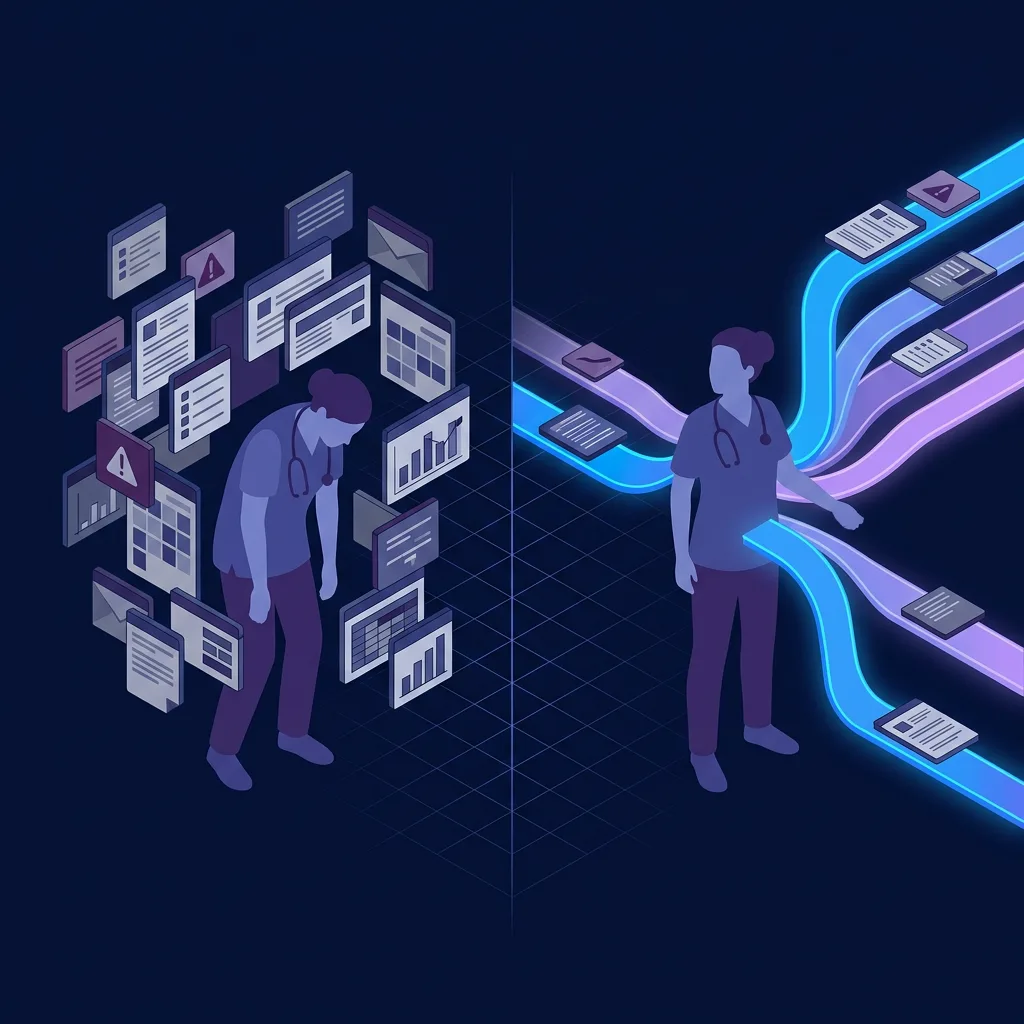
On average, healthcare workers spend 40% of their working time on administration. Nearly half of every working day is not spent on direct care delivery. The same information is entered into multiple systems because those systems do not communicate with one another.
Relevant client information is scattered across different systems and departments. Professionals spend valuable minutes searching for records, consulting colleagues, and navigating non-integrated applications.
The result is a vicious cycle: high administrative burdens lead to greater workload, which leads to higher absenteeism, which leads to even greater workload for the remaining staff.
Workflow automation as a structural solution
Technology is not meant to replace people. The purpose of workflow automation is to free professionals from repetitive tasks, giving them more time for what truly matters — personal contact with clients and patients.
Intake requests are automatically processed, classified, and routed to the appropriate department or care provider. Clients complete questionnaires at home via a secure portal. Responses flow automatically into the electronic client record, ensuring the professional already has the relevant information available at the first consultation.
Smart scheduling software accounts for availability, travel time, competencies, and client preferences. When systems communicate seamlessly, the need for duplicate data entry disappears.
Digital tools that make a difference
Clients and informal caregivers gain access to a secure portal where they can view appointments, upload documents, and send messages. This drastically reduces the volume of phone calls and gives clients greater control over their own care journey.
Video consultation enables hybrid care models in which face-to-face contact is combined with digital check-ins. By analyzing data intelligently, risks can be identified at an early stage. A combination of in-person and digital care contact often reaches more clients with the same capacity, without sacrificing the human dimension.
In our portfolio cases, we observe that an integrated approach can lead to substantial reductions in administrative burden — without additional staff. The gain lies in eliminating duplicate data entry, automating routine tasks, and scheduling care moments intelligently based on up-to-date client information.
Voice-driven documentation: from consultation notes to SOAP
One of the most immediately impactful technological advances is voice-driven documentation. The care professional conducts the conversation; the software records, structures, and delivers a draft report presented in the familiar SOAP format (Subjective, Objective, Assessment, Plan).
It saves 5–10 minutes per consultation — not through typing speed, but because the professional can remain fully focused on the client during the conversation. The documentation is completed afterward, in draft form, at a convenient moment. The cognitive burden of 'listening and taking notes simultaneously' is eliminated.
A key prerequisite: voice recordings must not be stored permanently, and transcripts must be processed within an EU environment. This rules out a number of hosted SaaS solutions and points toward on-premise or EU-cloud deployments. It makes the choice of vendor a substantive one.
Smart scheduling: maximizing capacity without overburdening staff
Scheduling in healthcare is a complex optimization challenge. Availability, travel time, professional competencies, client preferences, geographic clustering — a scheduler must hold all of these variables in mind simultaneously. Good scheduling software relieves that burden without replacing the scheduler.
In practice: the system calculates feasible schedules that satisfy all hard constraints and proposes prioritized solutions based on soft preferences. The scheduler accepts, adjusts, or overrides based on contextual knowledge the system does not possess. Time savings are substantial, particularly in scenarios with rapidly changing availability — absenteeism, urgent requests, last-minute changes.
The side effect is at least equally valuable: care professionals receive rosters that account for their own preferences — no unfavorable shift transitions, no unnecessary travel time, no fragmented shifts where avoidable. What is good for the organization often turns out to be good for the employee as well.
Predictive monitoring: from reactive to proactive
In chronic care and community nursing, continuous monitoring enables a shift from reactive to proactive care. Wearables, home measurements, and self-reported data provide signals that — when viewed in context — can give early warning of deterioration.
A diabetes patient with unexpected glucose patterns, a heart failure client with weight gain, a COPD patient with declining activity — these signals are not always individually alarming, but as a pattern they may indicate deterioration. An AI monitoring system can detect such patterns in time and alert the care coordinator.
An important prerequisite: this must not overwhelm the professional with false positives. The UI design — 'which alerts to surface, and when' — is as important as the detection algorithm. A well-designed monitoring system should be calibrable to the needs of this specific client and this specific context.
What makes the difference for healthcare professionals
Technology in healthcare is frequently criticized for 'just adding more work.' Too often, that criticism is justified: new systems, new accountability requirements, duplicate documentation. But the right technology does the opposite — and when it does, the difference for the working professional is tangible.
Less administrative burden means more time for client contact. Greater client autonomy means fewer phone calls asking 'when is my appointment.' Smart scheduling means realistic working days. Voice-driven documentation means no longer having to update records at home after hours.
The impact on job satisfaction and retention is significant. A professional who structurally spends 40% of their time on administration will inevitably face burnout over time — regardless of how strong their motivation is. Technology that halves that burden does not only give back time; it restores the sense of purpose that drew people to healthcare in the first place.
That is ultimately what every buy-and-build and investment decision in health tech comes down to: does this technology make care more human or more mechanical? The entire ecosystem stands or falls on that single question.