The fragmented healthcare landscape
Dutch healthcare ranks among the best in the world, yet behind the scenes the sector grapples with a fundamental challenge: more than 1,000 different software systems that barely communicate with one another.
Patients must share their medical history anew with every care provider. General practitioners have no visibility into medications prescribed by specialists. Nurses manually enter the same data into multiple systems.
The Nictiz Monitor Digital Care shows that 70% of healthcare organizations are actively seeking solutions for better data exchange. Interoperability is no longer a luxury — it is a necessity.
“1,000+ systems that don't communicate — interoperability is no longer optional.”
Wegiz and EHDS: legislation as a catalyst
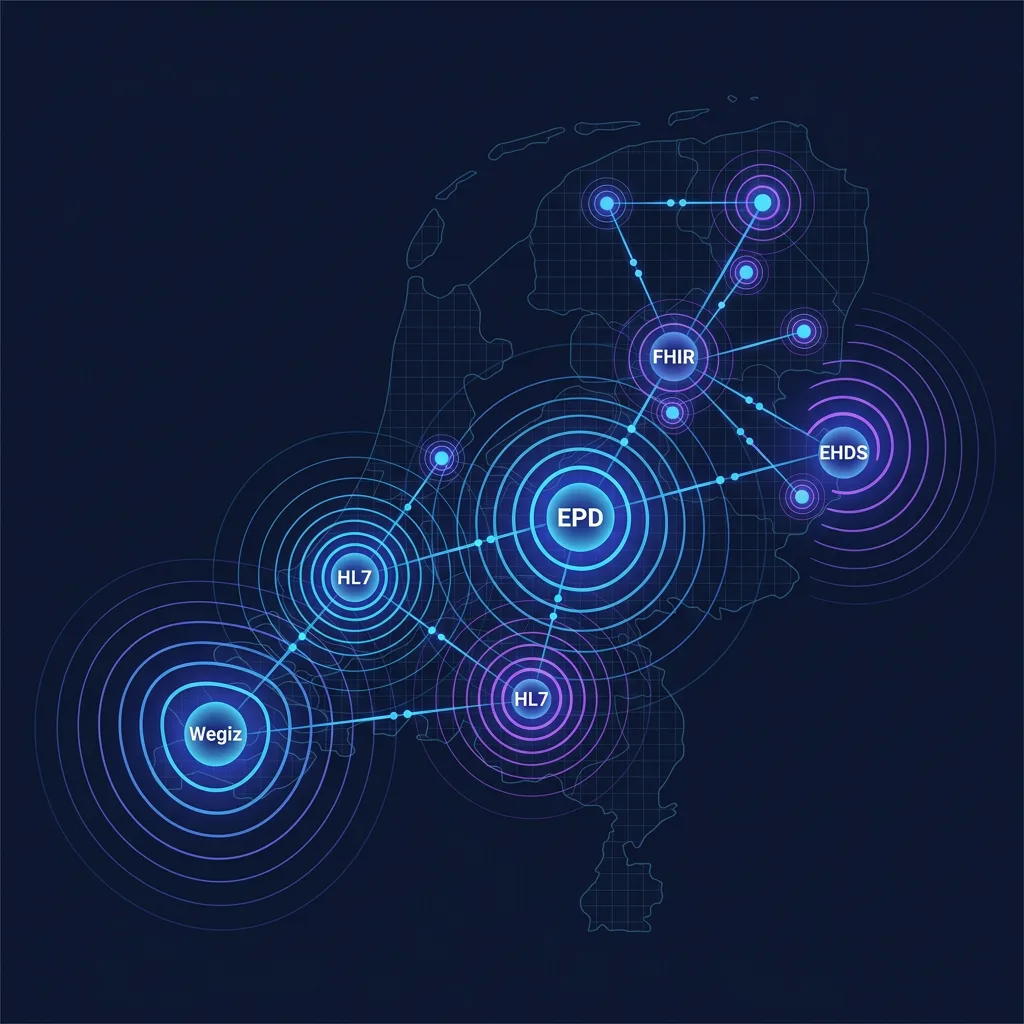
Wegiz requires healthcare providers to exchange patient data electronically. For the first time, digital data exchange is no longer voluntary but legally mandated. The first tranche makes the digital transfer of medication records and nursing handovers compulsory.
At the European level, the European Health Data Space (EHDS) establishes a uniform framework for health data. Implementation deadline: 2027.
This legislative triad — Wegiz, EHDS, and IZA — represents an unprecedented catalyst for standardization. Organizations that invest in interoperable systems today build a meaningful competitive advantage.
FHIR and HL7: the technical standards
HL7 (Health Level Seven) has been the international standard for exchanging medical messages for decades. FHIR (Fast Healthcare Interoperability Resources) is its successor and is revolutionizing the healthcare sector.
Unlike traditional message-based exchange, FHIR uses modern RESTful APIs — the same technology powering applications such as iDEAL and DigiD. Data is structured in resources (Patient, Observation, MedicationRequest) that can be queried and shared in real time.
Interoperability without security is irresponsible. NEN 7510 forms the security foundation underpinning all data exchange. Every FHIR or HL7 implementation must comply with this standard.
The role of the CareHub ecosystem
Legislation and standards create the framework, but the real transformation takes place in practice. CareHub connects complementary health technology companies, each serving a specific segment of the care continuum.
Within CareHub, interoperability is not an afterthought but a core architectural principle. All affiliated companies implement FHIR interfaces and HL7 integrations. The starting point is that a new portfolio component fits into the ecosystem from day one — not that an integration project has to be retrofitted afterward.
What sets CareHub apart from standalone integrations is the ecosystem approach: rather than point-to-point connections, CareHub offers a shared integration layer. Interoperability that does not remain theoretical but functions daily — maintained by a single team rather than fragmented across twenty vendors, each with their own interpretation of what 'FHIR' means.
FHIR resources: what it looks like under the hood
FHIR works with 'resources' — standardized data objects for specific care concepts. Patient contains a client's identity; Encounter represents a care contact; Observation a measured value or finding; MedicationRequest a prescribed medication. In total, more than a hundred resources collectively cover the healthcare domain.
For the Dutch context, Nictiz publishes profiles — specifications that refine FHIR resources for the Dutch healthcare landscape. These include profiles for BgZ (Basic Dataset Care), medication transfer, and nursing handover, which align directly with Wegiz requirements.
A sound FHIR implementation is more than publishing an API. It requires mapping existing domain data to FHIR resources without information loss, supporting search queries and search parameters, correctly handling versioning, and implementing access and authorization patterns that function in a multi-organization context. That is where the real engineering lies.
Wegiz tranches and what they require of healthcare providers
Wegiz is being implemented in tranches. The first aspect of each tranche is the subject that must be exchanged digitally and in a standardized manner; the second is the implementation date by which this must be operational.
The first tranche covered medication transfer and nursing handover — two exchanges where fragmentation demonstrably leads to incidents. Subsequent tranches address other core datasets and exchange scenarios. For healthcare providers, this means: do not wait for the exact deadline, but configure the architecture for standardization now so that each new tranche becomes an implementation project of weeks rather than months.
The compliance pressure is real: healthcare providers that fail to comply risk enforcement action, but more importantly, the procurement conditions of health insurers and municipalities increasingly depend on demonstrable digital data exchange. Organizations that can demonstrate Wegiz compliance win procurement processes over those that cannot.
EHDS: the European framework
The European Health Data Space (EHDS) is more than an extension of Wegiz to the European level. It governs two matters not yet as explicitly regulated in the Netherlands: the primary use of health data (delivering care, informing treating clinicians) and secondary use (research, policy, innovation) — under uniform rules and with cross-border access where relevant.
For healthcare organizations, this means: the FHIR implementation you are building now for Wegiz is the same infrastructure that will serve EHDS. No separate stack, no separate auditing, no separate security controls. The investment in standardization pays dividends on two fronts.
For health tech companies and researchers, it means: structured, standardized access to anonymized or pseudonymized health data for research and product development — under strict governance. This opens a market that currently still largely runs on individual agreements and pilot projects.
EHDS implementation deadline: phased rollout from 2027. That may seem distant, but the architectural choices you make today determine whether you will be ready or not. Organizations that still opt for closed data models now are buying themselves a rebuild problem in two to three years.