Shift toward the front end: from reactive to preventive care
One of the strongest signals at the congress was the explicit shift from treatment to prevention. The central question: from what perspective can people resolve their health questions at home? This is not an optional ambition — it is a necessity in a sector grappling with growing staffing shortages and rising healthcare costs.
Behind the political rhetoric lies a concrete agenda: greater emphasis on self-management, digital support, and mobilizing both care providers and clients.
The shift toward the front end requires digital tools that enable patients and clients to take control of their own health: personal health records (PHRs), mHealth apps for self-monitoring, and telehealth for low-threshold contact with care providers.
“Government, the field, and patients are all pushing in the same direction — digitalization is a necessity.”
The national EHR: not one system, but an ecosystem
The most powerful statement came from the panel discussion on networked care: a national EHR must be established. This call reflects a deeply felt frustration across the field. Care providers run up against the limitations of fragmented systems that do not communicate with one another on a daily basis.
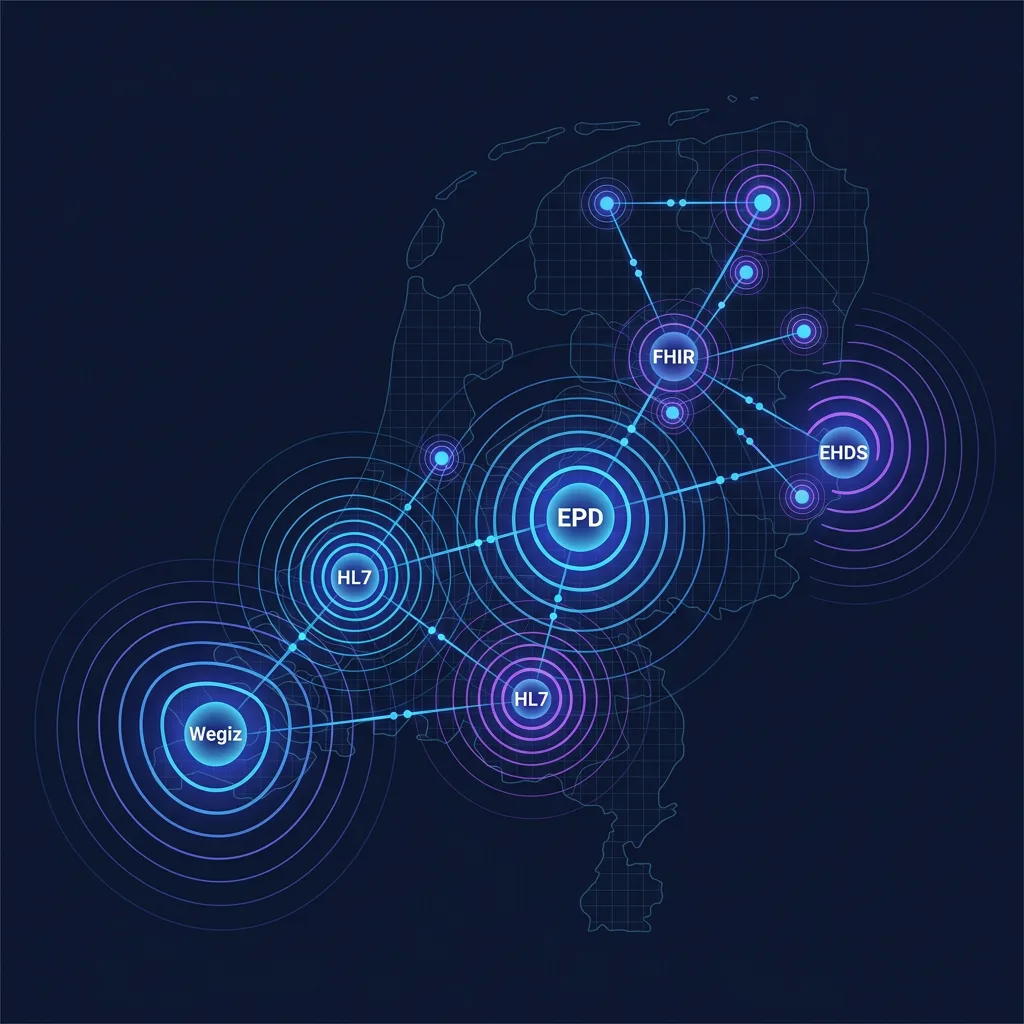
A single, centralized system for all of the Netherlands is both technically and practically unfeasible — the healthcare sector is too diverse, the systems too specialized. What is both feasible and desirable: a national interoperability layer connecting existing EHRs and ECDs via open standards.
The answer to the call for a national EHR is therefore not one new system, but an ecosystem of connected systems. This is precisely the approach of the CareHub ecosystem: connecting existing software via open standards, without vendor lock-in, while preserving sector-specific specialization.
What this means for investors in health technology
The signals are unequivocal: the Dutch government, the healthcare field, and the patient movement are all pushing in the same direction. Digitalization is no longer an option but a requirement. The IZA ambitions, the Wegiz mandate, and political will are creating a unique market environment for health technology investment.
Wegiz mandates digital data exchange — compliance-driven demand. The shift toward the front end is driving a growing market for digital health. Staffing shortages make technology a necessary solution — no longer a choice of efficiency but a choice of capacity.
Health technology companies that combine interoperability, workload reduction, and client self-management occupy the sweet spot of this market dynamic. Government supports that direction, the field demands it, and legislation mandates it.
Three themes that dominated the agenda
For those who were not there: three topics recurred in virtually every session. First: the gap between digital ambition and operational reality. Executives spoke in terms of 'digital transformation', while frontline staff discussed integration interfaces, duplicate data entry, and outdated portals. That gap — strategic optimism versus operational frustration — was repeatedly identified as the core problem slowing the digital agenda.
Second: the need for client-driven self-management. Personal health records (PHRs) were no longer discussed as 'nice to have' but as an infrastructural prerequisite for prevention and self-management. Without functioning client self-management, many other ambitions — prevention, hybrid care, informal caregiver support — cannot be structurally realized.
Third: AI as a realistic topic, no longer merely a promise. Whereas AI was still discussed in futuristic terms last year, the conversation now centered on concrete adoption questions: how do you certify a high-risk AI system under the AI Act? What pattern audits are required? How do you make explainability workable in a busy clinical setting? This demonstrates that healthcare AI is maturing — but also that the requirements are becoming more stringent.
What this means for healthcare organizations
The message for healthcare organizations is mixed: on one hand, there is clear political and sectoral backing for digitalization — on the other, healthcare organizations themselves remain responsible for implementation. Wegiz does not prescribe which system to use; it only mandates that the exchange functions.
In practice: organizations still making software choices today without enforcing open standards are purchasing a compliance problem two years from now. This applies to ECD replacements, EHR expansions, and all new specialized applications. Choose vendors that support FHIR or have a credible roadmap toward FHIR.
And: do not integrate everything at once. A phased approach — starting with the most pressing exchange need (medication handover, nursing handover) — works better than a large-scale integration program. Wegiz tranche phasing supports this by providing externally validated prioritization.
What this means for health tech companies
For healthcare software vendors, the signal is clear: open architecture is no longer a marketing claim but a product requirement. Closed data models that can only be accessed via vendor-specific interfaces are gradually losing their market value. Government is applying pressure through Wegiz; clients are applying pressure through procurement requirements.
The winners over the next five years will be the vendors that build their product to fit naturally within an ecosystem — not as a core component around which everything revolves, but as one of many components each fulfilling its own role. That mindset shift is greater than a technical upgrade; it is a reorientation of the business model.
Compliance is simultaneously becoming a differentiating factor. NEN 7510, ISO 27001, AI Act conformity — vendors who can demonstrate these with credible documentation will win procurement processes over those who cannot. This is not the non-committal 'we take security seriously' of the past; it is genuinely demonstrated compliance, with a verifiable audit trail.